
Venus Bounce Recovers a Message Across 84 Million Kilometers (52 Million Miles)
Back to Radio in the NewsA Venus bounce has delivered a readable digital message across approximately 84 million kilometers (52 million miles), advancing amateur-led planetary radio experiments beyond carrier detection. Volunteers at Dwingeloo in the Netherlands transmitted toward Venus on Oct. 17–18, and the team recovered “VENUS ECHO” from signals reflected back to Earth.
According to CAMRAS’s experiment report, the echoes reached the volunteer-operated Stockert telescope in Germany after a round trip of nearly five minutes. Recovering the message required more than 40 minutes of received echoes and a purpose-built M-FSK waveform developed with the Open Research Institute.
The result extends the same team’s 2025 carrier-detection experiment to message recovery. A Westerbork telescope also decoded the reflected message. Effelsberg, Lovell and other eMERLIN telescopes recorded signals for subsequent analysis.
A 25-Meter (82-Foot) Dish and 95.3 MW EIRP
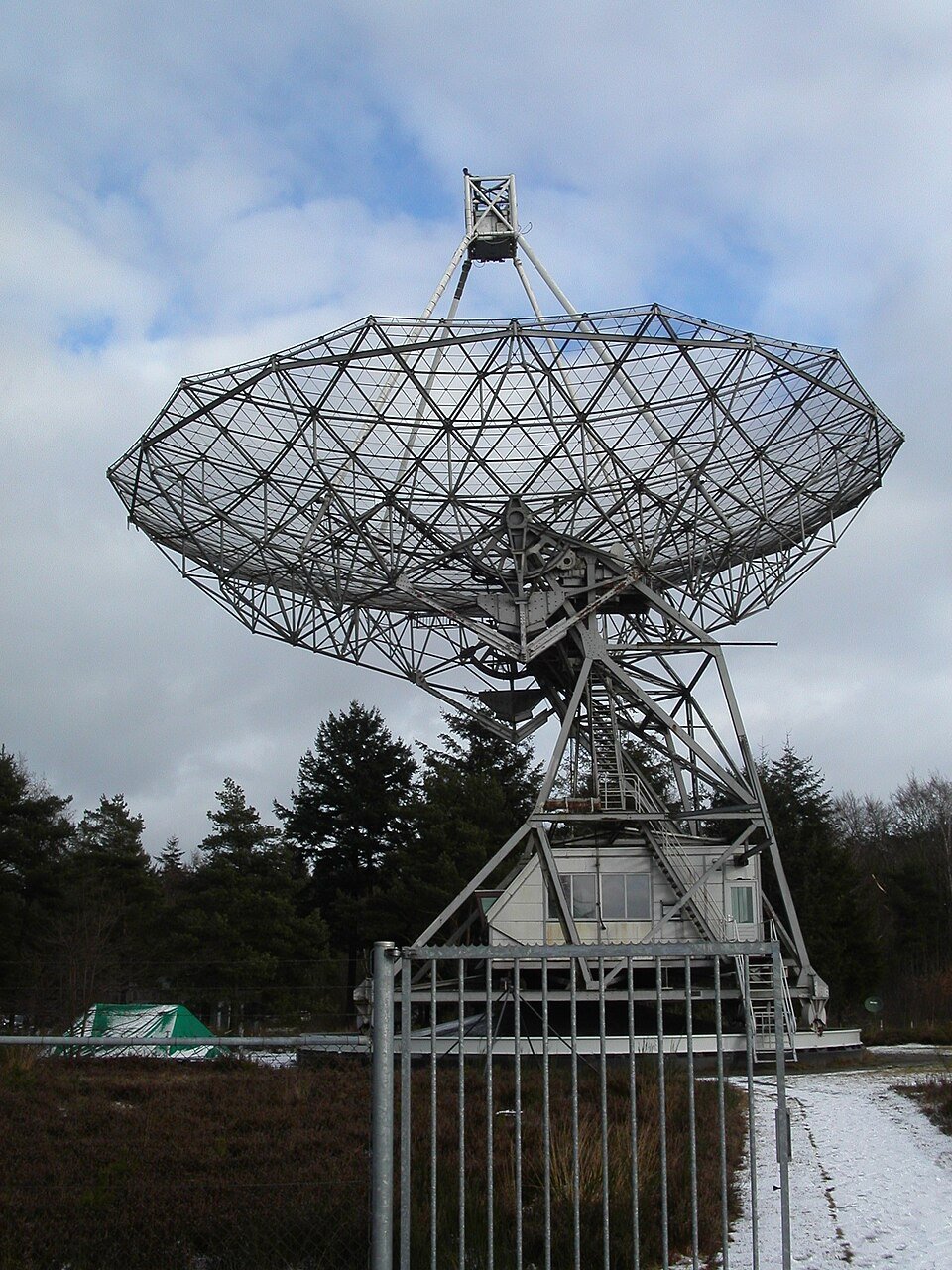
Dick Harms, PA2DW, lists the station’s operating figures in his October 432 and Above report: A 25-meter (82-foot) parabolic dish, right-hand circular polarization on transmit, left-hand circular on receive, and a maximum EIRP of 95.3 megawatts. The project frequency is listed as 1299.650 MHz.
That EIRP figure includes the dish’s gain; it does not mean the amplifier produced 95.3 megawatts. Concentrating the transmitted power into a narrow beam raises the effective radiated power in Venus’s direction. On receive, aperture and losses ahead of the low-noise amplifier remain critical.
Stockert’s separate receiving station offered another advantage: Its receive-only system did not require a transmit/receive isolation relay. Harms identifies that difference as useful in the receiving path, where even small losses matter.
Recovering Data From a Spreading Echo
Path loss is only part of the problem. ORI’s signal-design account describes how Venus’s rotation spreads reflected energy across frequencies and limits how long the receiver can combine samples while preserving their phase relationship.
The design approach combines samples coherently over short intervals, then accumulates their energy noncoherently over longer periods. That permits extended integration without assuming the echo remains phase-stable throughout an entire long symbol.
ORI’s published Spiral design uses 4,096 possible FSK tones, carrying 12 encoded bits per symbol. Eleven symbols provide 132 bit positions: A BCH(127,106) codeword and five padding bits. The codeword includes 90 message bits, a 16-bit CRC and 21 parity bits.
Those figures describe ORI’s published design work. The successful Venus test is documented by CAMRAS as a specially developed M-FSK transmission, with Harms crediting Thomas Telkamp, PA8Z, for the home-built FSK implementation. The experiment demonstrates message recovery under the actual planetary propagation conditions.
An Experimental Transmission, With Open Work to Follow
Harms says the high-power operation used a special experimental authorization and the identifier EVE26RD, rather than the ordinary PI9RD amateur conditions. It was a one-way experiment; the team was not offering two-way QSOs.
CAMRAS scheduled the campaign’s final Venus session for Oct. 25. Its report commits to publishing results and releasing the received recordings as open data. The confirmed decoded message establishes a concrete result for the campaign, while analysis of the other recordings continues.
For experimenters interested in the calculations, ORI’s public EVE repository contains a configurable link-budget notebook, signal-design material and a validation study using the March 2025 reception data. It provides a way to examine station gain, path losses and receiving bandwidth against an observed Venus echo.
Sources and Further Reading
- CAMRAS: Venus-Bounce Experiment and Decoded Message
- PA2DW: Station Details and Experimental Authorization
- ORI: EVE Signal Construction and Coding
- ORI: EVE Link Budget and Public Project Files