
Radio History from
General Order 40 Changes America’s Radio Dial
General Order 40 reorganized U.S. broadcasting assignments in a nationwide changeover at 3 a.m. Eastern Standard Time on November 11, 1928. Stations moved to new frequencies and operating arrangements intended to reduce interference and distribute broadcasting service more evenly, while listeners retuned to find familiar programs.
The Federal Radio Commission issued the order on August 30, ahead of the November transition. Its plan addressed a central problem in medium-wave broadcasting: A station’s signal could serve nearby listeners by day and travel far beyond that area after dark, interfering with stations elsewhere on the same frequency.
General Order 40 Organizes the Broadcast Band
The order defined a broadcast band from 550 to 1500 kilocycles per second, with 10-kilocycle spacing. In modern units, those are carrier frequencies from 550 to 1500 kHz, giving 96 channel positions. Six frequencies were reserved for Canadian stations, so the total did not represent 96 frequencies available for U.S. assignment.
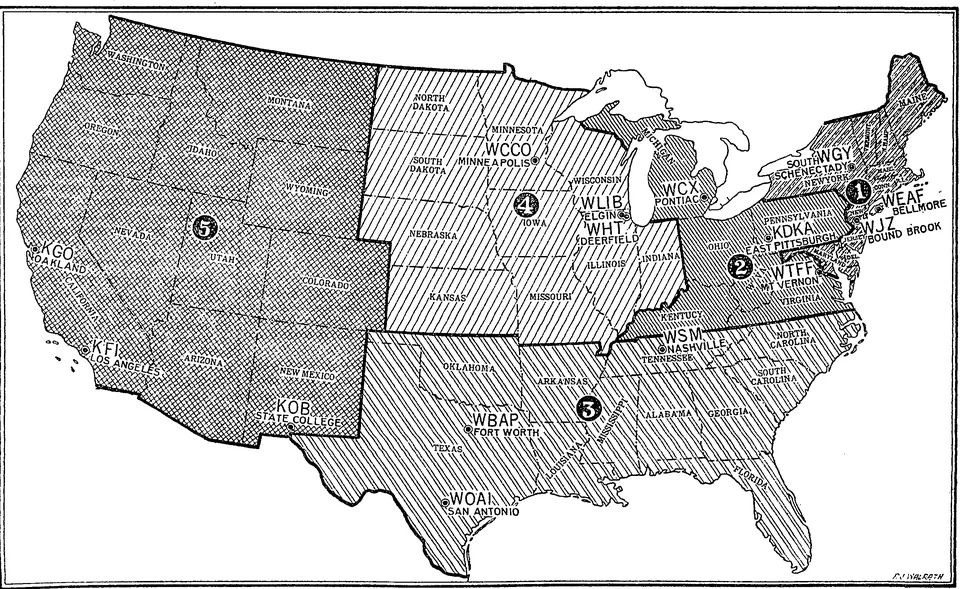
The commission divided assignments among five U.S. radio zones and provided different arrangements for wide-area, regional and local service. Some frequencies received strong nighttime protection; others were shared geographically by multiple stations. Time-sharing allowed stations to use the same frequency during different hours.
The revised assignment tables specified more than carrier frequency. Power limits, permitted operating hours and shared-time arrangements determined how a station could use its allocation. November 11 marked the implementation of those assignments, rather than the date the original order was issued.
Nighttime Skywave Complicates Channel Sharing
Medium-wave signals reach listeners through groundwave and skywave propagation. Groundwave travels along the Earth’s surface, with attenuation affected by frequency and ground conductivity. Skywave reaches the ionosphere and can be refracted back toward Earth at much greater distances.
During daylight, absorption in the lower ionosphere strongly attenuates many medium-wave skywave paths. After sunset, reduced ionization in the D region lowers that absorption, allowing distant stations to arrive more strongly. Groundwave continues through both periods.
The resulting interference can occur between stations separated by hundreds of miles. Clear-channel arrangements protected wide-area nighttime service, while regional and local assignments permitted more sharing. Frequency spacing, transmitter power, operating hours and geographic separation all affected the outcome.
Why Medium-Wave Radio Travels Farther at Night
The big change is reduced absorption below the regions that return skywave to Earth. Groundwave continues during both day and night.
Day: Strong Skywave Absorption
Sunlight sustains the D region. Collisions between electrons and neutral particles absorb much of the upward medium-wave signal. Nearby listeners generally rely on groundwave.
Night: Skywave Can Return
After sunset, D-region ionization drops sharply. More medium-wave energy can reach higher ionospheric regions and bend back to Earth, bringing distant stations onto the same channel.
How to Read This: Schematic, not to scale. A returning ray bends through an ionized region; it does not bounce off a solid ceiling. The return height and range depend on frequency, launch angle and ionospheric conditions. Daytime skywave is often strongly attenuated, not universally absent; nighttime signals still suffer losses and fading.
New Assignments Require Transmitter Retuning
Changing a station’s frequency required the transmitting equipment to operate correctly at its new assignment. The necessary work depended on the installation: Frequency-generating circuitry, tuned amplifier stages and the coupling or loading network feeding the antenna could require adjustment. A change did not necessarily require rebuilding the antenna.
The antenna’s electrical length changed with frequency even when its physical dimensions stayed the same. At 1 MHz, the free-space wavelength is approximately 300 meters, making a quarter wavelength about 75 meters, or 246 feet. These calculated dimensions indicate the scale involved; actual installations could use shorter antennas with loading and matching arrangements.
Frequency accuracy was also an established engineering concern. NIST’s history records that broadcasters’ difficulty staying on frequency drove the National Bureau of Standards to develop wavemeters and quartz frequency standards. It began broadcasting reference-frequency signals in 1923 and installed four quartz oscillators as its national primary radio-frequency standard in 1929.
General Order 45 Permits Overnight Tests
General Order 45, adopted September 24, 1928, allowed affected stations to test their new frequencies before the changeover and establish the required accuracy. The ordinary test period was 2–7 a.m. Eastern Standard Time east of the Mississippi River and 1–7 a.m. Mountain Standard Time west of it.
The permission was conditional: Tests had to avoid interference with other broadcasts and stop if interference developed. Stations could apply for daytime testing in particular cases when the commission judged that interference would not result. The order provided a defined opportunity to adjust equipment before regular operation under the new assignments.
Later Agreements Extend the AM Dial
Another major reassignment followed when the North American Regional Broadcasting Agreement took effect on March 29, 1941. The agreement coordinated use of the 550–1600 kHz broadcast band among participating countries to reduce cross-border interference.
Further changes extended the channel lineup. In 1991, the FCC adopted AM service-improvement rules covering expanded-band channels from 1610 through 1700 kHz. Current U.S. rules define the AM broadcast band as 535–1705 kHz, with 117 carrier frequencies from 540 to 1700 kHz at 10 kHz intervals. The band edges extend beyond the outer carrier centers because an AM signal includes sidebands.
The nearby U.S. amateur 160-meter allocation occupies 1800–2000 kHz. It is a separate service with related propagation conditions. The assignments established under General Order 40 have since evolved, but the need to coordinate groundwave service and nighttime skywave interference remains part of medium-wave broadcasting.
Sources and Further Reading
- Federal Radio Commission, 1928 Annual Report: General Orders 40 and 45 (pp. 48–50, 53); Revised Station Assignments (pp. 199–214)
- NIST: Time and Frequency Division History — Broadcast Frequency Standards
- FCC, 1958 Clear-Channel Proceeding, FCC 58-891: Groundwave, Skywave and Interference
- FCC, Seventh Annual Report (1941): North American Regional Broadcasting Agreement
- FCC, AM Service Improvement Rules, Federal Register, December 12, 1991
- 47 CFR 73.14: AM Broadcast Band and Channel Definitions
- ITU: Radio-Frequency Band Nomenclature (Band 6, MF)
- 47 CFR 97.301: U.S. Amateur Frequency Allocations
- NOAA: The Ionosphere
- E. K. Jett: Report on the North American Regional Broadcasting Conference, May 16, 1946, in Foreign Relations of the United States