
M17: Building an Open Digital Radio Ecosystem From the Ground Up
Back to Radio in the NewsM17 developers reported a successful radio-to-radio test in a Nov. 8 update, demonstrating how independently developed hardware and firmware can work together in an open digital radio ecosystem. The project brings a documented voice and data protocol together with an open-source speech codec, radio firmware and networking tools, giving amateurs access to technology they can inspect and modify.
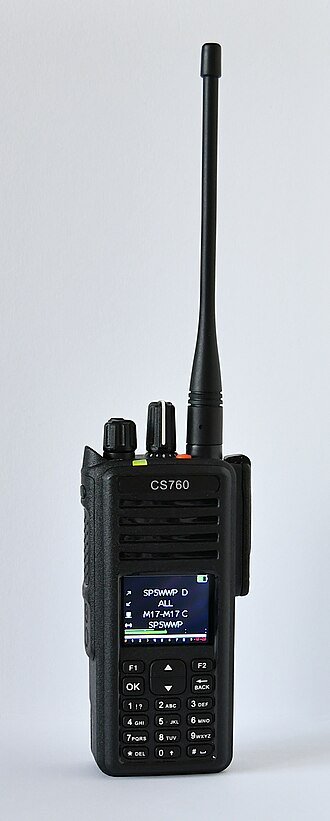
The test linked the experimental Linux-based LinHT handheld with a modified TYT radio running OpenRTX firmware. It illustrates M17’s broader aim of making compatible equipment possible without requiring one manufacturer to supply the entire system. Operators can also experiment with M17 through software-defined radios, external modems and compatible hotspots.
The freedoms differ across those projects. Much of the software permits commercial use under open-source licenses, while LinHT’s published hardware designs carry a noncommercial restriction. In a Nov. 9 commentary, founder Wojciech Kaczmarski, SP5WWP, defended that choice as a way to protect volunteer work. LinHT also remains a prototype, with RF measurements and production arrangements still pending in the development report.
An Open Digital Radio Ecosystem
M17 gives developers access to both the radio interface and the speech encoding. Its published specification describes how compatible stations exchange voice and data. Codec 2, developed by David Rowe and contributors, supplies the speech codec. That combination lets amateurs investigate or change the implementation without needing a proprietary speech-codec component.
OpenRTX provides replacement firmware with experimental M17 support on selected radios, sometimes requiring hardware modifications. Contributors can change radio controls, improve the interface or investigate faults. Installing replacement firmware does not, by itself, make the original radio’s hardware design available.
For software-defined radio development, gr-m17 implements the protocol within GNU Radio. Its loopback example allows signal processing to be tested in software before connecting RF hardware. A developer could investigate a decoder problem or test a different demodulator while preserving the format other M17 stations expect.
The same access extends to networking. The mrefd reflector forwards voice streams and data packets among connected stations. Jim Ancona’s M17 gateway and tools connect compatible CC1200, SX1255 and MMDVM modems to internet services. A club can maintain its own reflector or investigate a gateway fault using the published code.
These components can be developed separately and tested together. A change to a radio’s controls need not change its transmitted signal, and a different receiver implementation can still follow the same specification. Changes to the over-the-air format require coordination to preserve compatibility.
Published Designs Have Different Permissions
LinHT’s CC BY-NC-SA 4.0 hardware license permits sharing and modification with attribution, a noncommercial restriction and a requirement to share adaptations under the same terms. Commercial use of the licensed material requires separate permission. Free access to the files therefore does not give a company unrestricted permission to manufacture and sell the design.
That restriction falls outside both the Open Source Initiative’s definition for software and the open-source hardware definition. Both include commercial freedom. Publishing editable schematics is useful, but formal open-source status depends on the permissions as well as access to the files.
In his Nov. 9 commentary, Kaczmarski acknowledges that his interpretation differs from OSI’s. He argues that volunteers should not become an unpaid development resource for businesses that commercialize their work without reciprocity. He proposes that commercial users seek permission from the copyright holders.
The distinction does not apply uniformly across M17. Codec 2 uses LGPL 2.1, while OpenRTX and gr-m17 use GPL licenses; these permit commercial activity subject to their obligations. Module17 version 1.0, an external modem, is certified by OSHWA with hardware licensed under CERN-OHL-W-2.0. Each component has its own terms.
LinHT Connects the Components
LinHT combines a Linux system-on-module with a software-defined radio front end. Its public hardware documentation includes KiCad schematics, PCB layouts and manufacturing outputs. Builders still need purchased semiconductor components, a CompuLab module and a Retevis C62 donor radio. The mainboard files do not include designs for reproducing those commercial parts.
In the Nov. 8 Rev C report, developer Vlastimil Slinták describes an M17 transmission received by a modified TYT MD-UV390 running OpenRTX. He also reports working USB-C networking, audio, microphone, satellite positioning and power management.
Exact RF output, harmonics, efficiency and sustained-transmit thermal behavior remained unmeasured. A proposed first kit batch depended on component pricing and a sales decision. The report describes development progress, not a finished consumer radio or kits already available for purchase.
Other Ways to Use M17
Module17 connects to compatible transceivers through 9600-baud baseband connections, with levels adjusted for the particular radio. Its manufacturing files provide a route to obtaining boards. OpenRTX-supported radios and SDR implementations offer other approaches; hardware, firmware and software versions determine what works together. Participation in amateur radio operation requires an amateur radio operator’s license.
Configuration and infrastructure remain practical concerns. Ancona’s gateway documentation distinguishes current reflectors supporting packet services from legacy implementations with fewer capabilities. A compatible hotspot also needs suitable firmware. Published code alone does not establish local repeater coverage or an active group of operators.
A Documented Interface and an Open Speech Codec
M17’s air interface uses four-level frequency-shift keying at 4,800 symbols per second, carrying 9,600 raw bits per second with minimum channel spacing of 12.5 kHz. The specification provides 3,200-bit-per-second voice and a combined mode with 1,600-bit-per-second speech plus data, alongside separate packet operation. The raw rate includes framing and error protection.
Other digital modes also have published interfaces. DMR has an ETSI standard, and D-STAR is an open protocol developed by JARL. D-STAR voice uses AMBE; Tait’s DMR documentation identifies AMBE+2 as the proprietary codec adopted for multivendor compatibility. Yaesu’s System Fusion uses C4FM. A published interface or modulation scheme does not establish access to its implementation’s source code.
M17’s specification document uses the GNU Free Documentation License 1.3 or later; software included in it uses GPL version 2 or later. Reusing that document or its code has different licensing consequences from independently implementing the interface. M17’s contribution is the ability to examine and develop the protocol, speech codec, firmware and networking together, with compatible implementations already communicating.
Sources and Further Reading
- M17 Protocol Specification
- LinHT Rev C Development Report
- M17 Founder’s Licensing Commentary
- M17 Hardware and Software Repositories
- GNU Radio Development Toolkit
- CC BY-NC-SA 4.0 Terms