
Radio History from
SOS Morse Code Became an International Radio Distress Signal
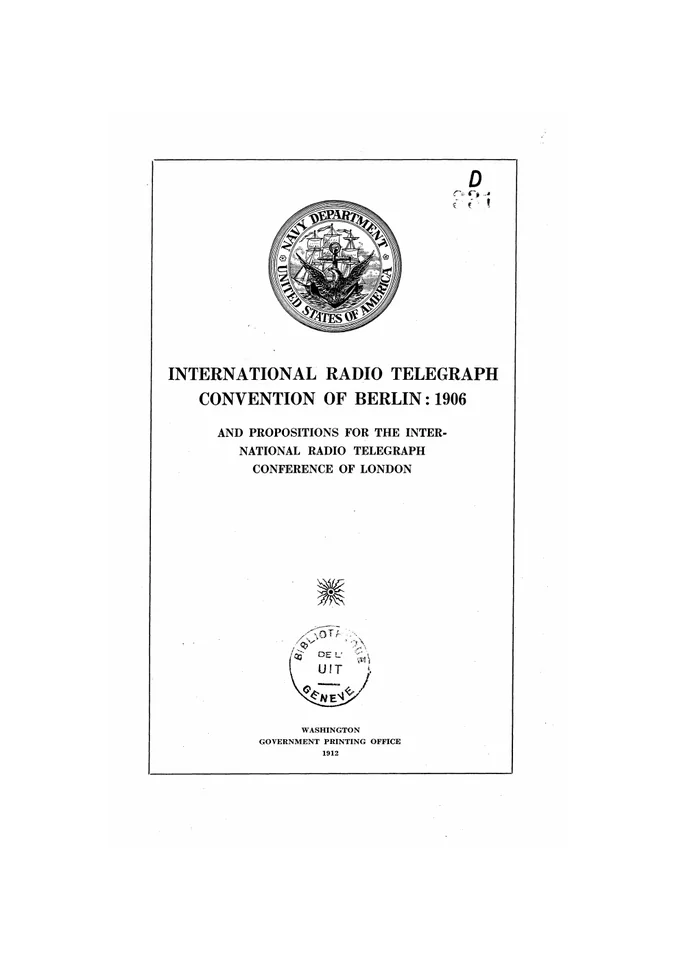
On Nov. 3, 1906, the International Radiotelegraph Conference in Berlin adopted the SOS Morse code signal for international maritime distress calls. Its service regulations required stations hearing ...---... to immediately stop all other correspondence; if the distressed ship did not name a station, every station receiving the call had to answer. The convention gave ships and shore stations a shared emergency procedure across national and company lines.
The Convention Defined What Stations Had to Do
The convention’s service regulations specified the signal as three dots, three dashes and three dots, with no spaces separating the groups. They also set out the response. A station that perceived the distress signal had to cease all correspondence and remain silent until the resulting assistance traffic ended. If the ship addressed a particular station, that station alone was responsible for answering. If it named none, every station that heard the call was bound to respond.
The convention assigned priority to the signal and placed a clear response duty on receiving operators. At sea, a ship in danger could not assume that every station within range used the same equipment or followed the same company procedures.
SOS Morse Code Was Specified as a Continuous Signal
The convention printed the distress call as ...---.... “SOS” is the familiar letter rendering of that continuous Morse sequence. The treaty specifies the dot-dash pattern without expanding the letters into an English phrase. The 2009 ITU recommendation on International Morse code lists S and O separately and specifies the ordinary spacing between letters; the distress call’s original continuous sequence did not include those inter-letter spaces.
The signal had appeared in German radio regulations in 1905 before the Berlin conference adopted it internationally. The conference selected a shared maritime procedure at a time when national rules and commercial wireless systems differed. Common operation depended on both a recognizable signal and an agreed response when it was heard.
The Agreement Took Effect in 1908
The convention was signed in Berlin on Nov. 3, 1906, but its provisions did not take effect that day. It entered into force on July 1, 1908. The agreement also addressed intercommunication between ship and shore stations without regard to the system in use, placing the distress procedure within a wider framework for international wireless cooperation.
By assigning a response as well as a signal, the convention made the distress call actionable across stations that might otherwise have followed different procedures. Its service regulations gave operators a shared sequence to recognize and a defined duty once they heard it.
Sources and Further Reading
- ITU: International Radiotelegraph Convention of Berlin, 1906 (Original English Text)
- ITU: History of the 1906 Berlin Conference and SOS
- ITU News: “Sending Out an SOS”
- ITU-R Recommendation M.1677-1: International Morse Code