
Radio History from
Parkes Radio Telescope Opened a New Era in Deep-Space Listening
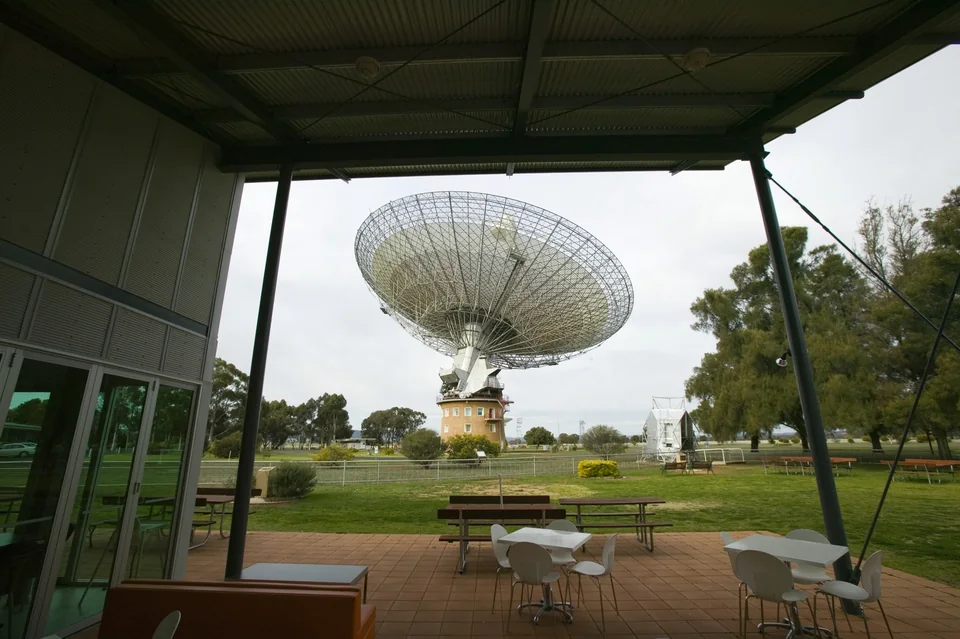
The 64-meter (210-foot) Parkes radio telescope opened in Australia on Oct. 31, 1961. Its large steerable dish was built to collect faint radio signals, and within a year it was helping track Mariner 2’s 960 MHz carrier during the spacecraft’s encounter with Venus. The work showed that antenna gain alone could not secure a weak signal: operators also needed accurate pointing and a precise frequency prediction.
Mariner 2 Tested the Receiving System
Attempts to detect Mariner 2 began on Dec. 12, 1962, two days before its closest approach to Venus. JPL supplied a modified phase-lock receiver for the 960 MHz carrier. Its tracking gate was only 20 Hz wide, and the dish’s narrow beam made accurate pointing essential. The experiment measured spacecraft position, signal level and Doppler frequency; it did not receive telemetry.
Engineers Doug Cole and Harry Minnett initially calculated the spacecraft’s position and Doppler shift by hand. After 100 hours without acquiring the signal, they contacted Woomera’s tracking facility and asked JPL to send updated predictions by telex. Both the pointing position and the received frequency had to be right.
With the updated predictions, the team found Mariner 2 at about 7 a.m. on Dec. 20 and tracked it for several hours, until the spacecraft set from Parkes’ view. The telescope’s measured threshold was −150 dBm; Mariner 2’s signal was about 4 dB above it. Doug Cole continued tracking at intervals through the Christmas period, until the signals ended on Jan. 3, 1963.
The tracking effort shows weak-signal reception as a complete system. Parkes’ large aperture provided gain, but acquisition depended on accurate pointing, a correctly tuned 20 Hz receiver gate and a reliable Doppler prediction. The carrier was only a few decibels above the system threshold.
A Large Movable Dish
Parkes grew from Australia’s postwar radio astronomy program at the Commonwealth Scientific and Industrial Research Organisation (CSIRO). Physicist E.G. “Taffy” Bowen proposed a major telescope as the field moved beyond its early improvised instruments. After design work in the 1950s, construction began in 1959. The telescope opened on Oct. 31, 1961, and was handed to CSIRO after acceptance testing in March 1962.
Its alt-azimuth mounting moves the dish in azimuth and elevation to follow sources across the sky. The large reflector gathered more energy from a source than a smaller antenna, while its narrow beam demanded accurate tracking. Parkes’ design also influenced later large radio telescopes, including antennas developed for NASA’s Deep Space Network.
An Early Model for Deep-Space Tracking
The opening established a major research instrument; the Mariner 2 work soon demonstrated its value for spacecraft reception. The tracking effort linked antenna gain, receiver bandwidth, pointing and Doppler prediction, and helped establish Parkes as a partner in later deep-space missions.
Sources and Further Reading
- CSIROpedia: Parkes Radio Telescope Construction
- NASA History: 50 Years of Solar System Exploration, Chapter 11, “Mariner 2 and the CSIRO Parkes Radio Telescope”
- CSIRO: Murriyang, Our Parkes Radio Telescope