
Radio History from
STS-61-A Takes Ham Radio Along With Spacelab
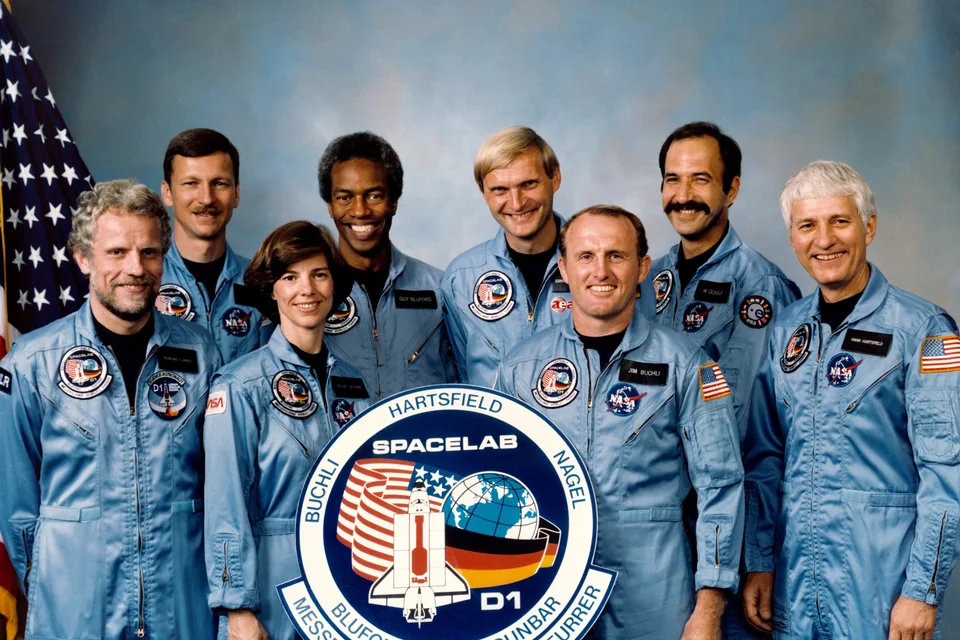
Challenger launched on STS-61-A on October 30, 1985, carrying an amateur-radio station alongside the German Spacelab D-1 laboratory. Operating as DP0SL, crew members made voice contacts with stations on Earth and used a tape recorder to receive calls while they were occupied with other duties.
The flight gave amateur operators a direct role in communicating with a spacecraft during a scientific mission. Its eight-person crew carried out a program of 75 numbered experiments in materials science, life science, technology, communications and navigation.
DP0SL Connects Crew Members With Ground Stations
Payload specialists Reinhard Furrer, DD6CF, and Ernst Messerschmid, DG2KM, were licensed radio amateurs. Recordings collected by Matthias Bopp, DD1US, preserve their activity as DP0SL, including calls in Morse code and live voice exchanges.
One recorded contact took place on November 3, 1985, when Messerschmid spoke with Horst Ellgering, DL9MH, operating club station DK0SG. Ellgering had helped train Messerschmid before the flight. The exchange was recorded on a 145.575 MHz FM downlink in the 2-meter amateur band.
Orbital Passes Limit Contact Time
A ground station could communicate with Challenger only while the spacecraft was within radio range. Its motion changed the direction of the signal path and produced Doppler shift, raising the received frequency during approach and lowering it as the spacecraft receded. Antenna orientation and obstructions near the horizon could further affect reception.
Crew availability imposed a separate limit. Spacelab experiments and other mission duties continued during the flight, so a pass over a ground station did not necessarily coincide with an opportunity for a live contact.
Recorded Calls Extend the Experiment
DP0SL also transmitted an automatic Morse-code announcement inviting stations to call. A tape recorder aboard the shuttle stored incoming voice calls for later playback when a crew member was available.
This arrangement allowed ground transmissions to be received without a crew member continuously attending the radio. The archive preserves both the automatic announcement and live exchanges; a recorded incoming call and a completed two-way voice contact were separate forms of participation.
Amateur Radio Continues Aboard the ISS
STS-61-A flew thirteen years before the first International Space Station module, Zarya, launched in November 1998. Amateur radio later became an established activity aboard the station through Amateur Radio on the International Space Station, or ARISS.
The program supports scheduled educational conversations with crew members as well as amateur voice, packet-data and image activities. Its FM cross-band repeater receives on one amateur band and retransmits on another, enabling contacts between ground stations within the same orbital coverage area without an astronaut operating the microphone.
Packet/APRS operation relays digital information, while scheduled slow-scan television events transmit audio signals that receiving stations decode into images. These modes provide different ways to use the station’s radio equipment, with availability governed by equipment condition and mission activities.
DP0SL combined live crew contacts with unattended reception during a working laboratory mission.
Sources and Further Reading
- ARISS: Current Status of ISS Stations — Radio modes, availability and expected interruptions.
- NASA: STS-61-A Mission Overview — Launch details, crew and the Spacelab D-1 research mission.
- DD1US: Sounds From Amateur Radio Missions on Space Ships and Space Stations — DP0SL recordings and operating notes, including the November 3, 1985, contact between Messerschmid and DL9MH at DK0SG.
- NASA: Zarya Module — The first ISS module, launched on November 20, 1998.
- ARISS: Amateur Radio on the International Space Station — Educational contacts, amateur-radio activities and program news.
- ARISS: Contact the ISS — Operating information for the station’s amateur-radio systems.