
.jpg)
The Arecibo radio telescope opened in Puerto Rico on November 1, 1963, giving scientists a 1,000-foot antenna for studying Earth’s ionosphere and radio signals from space. Its 305-meter reflector was the world’s largest radio telescope at the time. Fifty-seven years later, the collapse of its suspended instrument platform would bring that work to an abrupt end.
The observatory grew from work by Cornell electrical engineering professor William E. Gordon and his colleagues. Backed by the Advanced Research Projects Agency, the project combined a radar experiment with a collecting area large enough to support a much broader scientific program. The opening established a new place to investigate radio propagation and the sky with the same instrument.
The Ionosphere Became Something to Measure
Arecibo was originally conceived for radar studies of the ionosphere, the electrically charged upper atmosphere that matters so much to HF propagation. Instead of relying only on signals that happened to arrive, researchers could transmit radio energy and study the very weak scattering returned by ionospheric plasma.
The technique, called incoherent scatter radar, uses the returned signal to investigate properties such as electron density, temperature and motion. A powerful transmitter provides the illumination; a sensitive receiving system collects and measures the faint response.
For an operator accustomed to judging an HF path by the stations getting through, this is a direct extension of the same interest. The ionosphere was the subject of the experiment, rather than simply the route carrying a contact. The large antenna helped make those weak returns useful measurements.
The Reflector Stayed Put
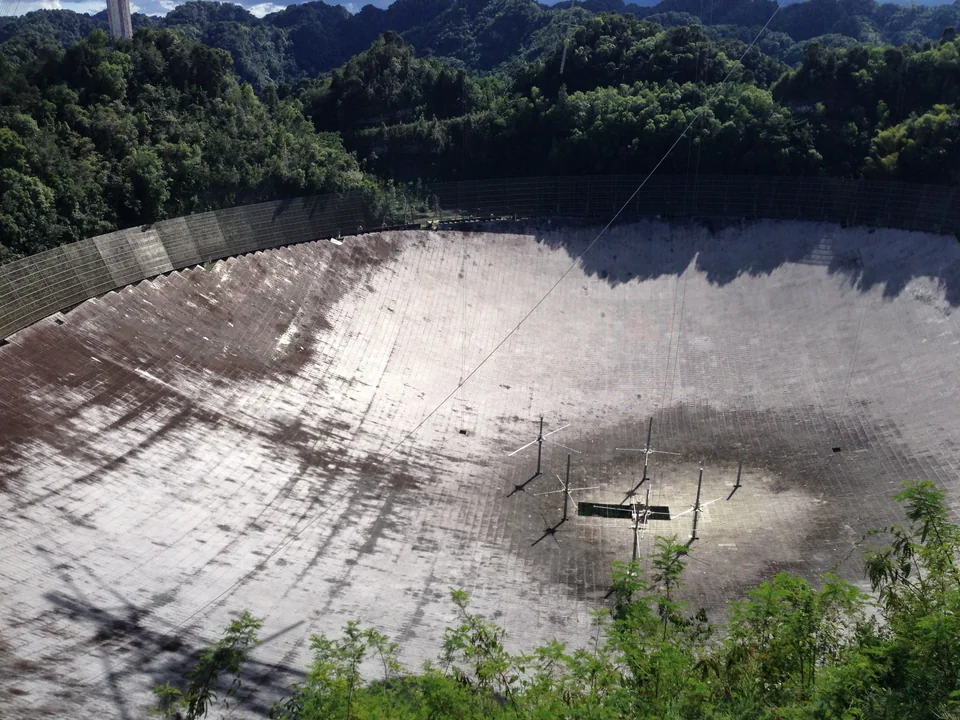
The main reflector was fixed in a natural limestone depression. It was spherical, rather than the familiar steerable parabolic dish. The suspended feed system selected observing directions within the telescope’s accessible part of the sky, avoiding the need to move the entire 305-meter structure.
That geometry made the feed an important part of the design. A spherical reflector does not bring all incoming parallel rays to a single point as an ideal paraboloid does. Arecibo used line feeds to collect the reflected energy; later upgrades introduced a Gregorian reflector system.
The opening-era surface was wire mesh. Cornell’s history describes that original reflector as limited to operation below 600 MHz. The accurately shaped aluminum panels associated with later photographs arrived in an early-1970s upgrade, extending the useful frequency range. Arecibo’s size was remarkable from the beginning, while its surface and feed engineering continued to develop.
How Arecibo Tracked Objects With a Fixed Dish
The 305-meter reflector stayed in place. Motors repositioned the feed above it to keep the antenna pointed toward a target.
Two Motions Set the Direction
Top View · Dashed: earlier setting · Solid: later setting
The azimuth arm rotated beneath the suspended platform. The feed carriage moved along the curved arm. Together, these motions set the direction around the horizon and the angle from overhead.
Orange arrows show mechanical motion. The outer circle is the fixed dish; the small rectangle is the feed carriage.
Tracking Had a Limited Window
Side View · Dashed vertical: straight overhead
The blue region shows the accessible sky, roughly 20° from straight overhead, called the zenith. As Earth rotated, a celestial source appeared to move across the sky. The feed system followed it while it remained within reach.
Orange circles show two positions of one source. The dashed orange line is a pointing direction, not a reflected ray path.
Conceptual views, not to scale. Feed hardware changed over the telescope’s lifetime. The original line feeds and later Gregorian system corrected the spherical reflector’s focusing geometry.
Transmitting with a Radio Telescope
Radio astronomy could use the collecting area to receive natural emissions from celestial sources. Radar added an active mode: transmit a known signal and study what returned. The two approaches shared an antenna but asked different questions of the received energy.
The same collecting area could capture faint natural emissions or the weak echo of a transmitted signal. Losing the antenna meant losing both capabilities at that scale.
Warning Signs in the Support System
Keeping the feed system suspended above the dish required a network of steel cables and secure end fittings. The telescope’s eventual failure developed in those fittings, not in its receivers or transmitters.
The National Academies’ 2024 investigation found that cable pullout increased after Hurricane Maria in 2017. Those growing movements should have prompted urgent action. Inspection coverage and documentation had also diminished; the committee could not determine how much reduced funding contributed to that decline.
How the Arecibo Radio Telescope Failed
An auxiliary cable pulled out of its socket on August 10, 2020, damaging the reflector. A main cable failed on November 6, before planned stabilization work began. NSF announced on November 19 that repairs could not be made safely and that the telescope would be decommissioned.
The structure failed before a controlled dismantling could take place. On December 1, 2020, another cable-socket assembly gave way. The suspended platform fell into the reflector, destroying the 305-meter telescope.
The investigations identified zinc creep in the cable sockets as the central failure mechanism. Creep is gradual deformation under sustained load. In these fittings, it allowed movement and damage within the cable termination until the joint could no longer carry its load. A cable’s nominal breaking strength did not describe the deteriorating connection’s actual condition.
What Remains After the Collapse
The giant telescope has not been rebuilt. NSF’s 2022 plan for an education center specifically excluded rebuilding the 305-meter instrument. The Arecibo C3 program subsequently developed science, computing and community education at the historic site, describing that new role in an October 2025 announcement.
That educational work continues a different part of Arecibo’s mission. It does not restore the collecting area or transmitting capability of the telescope that opened in 1963.
Sources and Further Reading
- DARPA: Arecibo Observatory
- Cornell Chronicle: Some Facts and a Little History About Arecibo
- NSF: Arecibo Preservation Principles and Management Plan
- MIT Haystack: Incoherent Scatter Radar Ionospheric Model
- Arecibo Spherical Reflector and Feed Study (NASA Technical Reports Server, 1969)
- National Academies: Failure Analysis of the Arecibo Observatory 305-Meter Telescope Collapse (2024), Summary
- NASA Engineering and Safety Center: Arecibo Socket Joint Failure Analysis, Technical Bulletin 21-05 (2021)
- NSF: New Education Center at Arecibo Observatory (October 13, 2022)
- Arecibo C3: Bringing STEM Education From Arecibo to the World (October 23, 2025)
- NSF: Arecibo Observatory Historic District