
Amateur Radio Is On
HF Propagation Outlook

Geomagnetic Outlook Remains Below Storm Levels

No geomagnetic storms expected through Wednesday. Minor-to-moderate radio blackout chance: 5% today.

Forecast Details →

NOAA · Nov. 23 12:30 UTC

Radio in the News

Cal Poly AREDN Project Links Three Central Coast Counties

The Cal Poly AREDN project has linked Monterey, San Luis Obispo and Santa Barbara counties through radio connections that can carry email and voice traffic without commercial internet service. Completed Oct. 3 and announced by the university Nov. 10, the expansion gives emergency volunteers a regional communications path when conventional networks are disrupted.

M17: Building an Open Digital Radio Ecosystem From the Ground Up

M17 developers reported a successful radio-to-radio test in a Nov. 8 update, demonstrating how independently developed hardware and firmware can work together in an open digital radio ecosystem. The project brings a documented voice and data protocol together with an open-source speech codec, radio firmware and networking tools, giving amateurs access to technology they can inspect and modify.

FCC GMRS Interference Notice Details Southern California Investigation

An FCC GMRS interference notice issued Nov. 4 orders Jerry Lee Seehaas, KG6UMF, to stop unauthorized transmissions and harmful interference. Agents traced repeated siren signals on two Southern California repeater inputs to radios in his vehicle in El Segundo, California, the notice says.

Amateur Radio Is On

Menu
  • Home
  • Ham Radio
  • News
  • History
  • Log/Spot
  • About
    • About This Site
    • Privacy
    • Contact
    • Terms
Menu
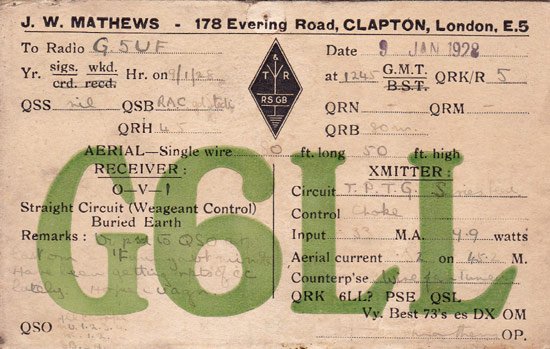
G6LL QSL card from J. W. Mathews in Clapton, London, addressed to G5UF and dated January 9, 1928.
G6LL’s QSL card to G5UF, dated January 9, 1928, lists Mathews’s London address and station equipment. From the estate of G5UF; courtesy of G3NDC, via Hamgallery. Image unchanged.

Radio History from October 21, 1928

G6LL Establishes a Ten-Meter Amateur Radio First Across the Atlantic

Posted on

October 21, 2026

British amateur Jimmy Mathews, G6LL, contacted W2JN in New Jersey on October 21, 1928, completing the first known two-way ten-meter amateur radio contact between England and North America. His homebuilt station established a sustained Atlantic link on a band British experimenters were only beginning to explore.

The achievement combined transmitter construction, antenna work and patient operating. Ten meters offered another route for long-distance amateur communication, but obtaining a useful signal at those frequencies required equipment built for the task.

A CQ Call Started the Contact

At 14:30 GMT, Mathews heard W2JN calling CQ and answered. The American station replied with a signal report and congratulations on the first ten-meter contact between the two countries. In a letter written three days later, Mathews reported that communication continued for an hour and three-quarters.

The exchange demonstrated more than the reception of a distant signal. Both operators could transmit, receive and acknowledge one another over the same Atlantic path.

Other British amateurs were listening. Jack Partridge, G2KF, reported hearing W2JN and two other American stations that Sunday afternoon, although his own attempts to contact them were unsuccessful. The reports captured an opening that several stations could hear, with G6LL completing the two-way connection.

A Homebuilt Transmitter and a Wire Antenna

The RSGB’s contemporary report credited G6LL with a crystal-controlled transmitter and 50 watts of input to its power amplifier. His antenna was a half-wave vertical wire with a Zeppelin feed, reaching a maximum height of about 40 feet.

Crystal control provided a stable frequency reference. The transmitter still had to generate useful radio-frequency power on ten meters and deliver it to the antenna. The installation combined those requirements in an amateur-built station.

The 50-watt figure describes electrical power supplied to the amplifier, not power radiated by the antenna. Transmitter losses meant those quantities were different.

Ten Meters Added Another Long-Distance Path

Ten-meter signals can travel far beyond the horizon when the ionosphere refracts them back toward Earth. The availability of that path changes with ionospheric conditions, including solar activity. A working transmitter and receiver are essential, but propagation determines when distant stations can communicate.

That remains part of ten-meter operating. A band that supports strong intercontinental signals during an opening can offer very different results when conditions change.

For British amateurs in October 1928, G6LL and W2JN supplied a concrete result: A two-way Atlantic contact made with amateur equipment on ten meters. Their achievement gave other experimenters a documented connection to follow.

Sources and Further Reading

  • J. W. Mathews and J. A. Partridge: Contemporary Letters in Wireless World, November 1928
  • RSGB: November 1928 Report Reproduced in RadCom, November 2003
  • ARRL: The Sun, the Earth, the Ionosphere

Explore More Radio History…

Share This Article

If you found this article helpful, share it with fellow amateur radio operators. Spread knowledge.

FacebookLinkedInXRedditEmail
Enable JavaScript to View Clocks.

[ RF PREP ]

Free Ham Study

Only the Right Answer.
Clear explanations.

TechnicianGeneralExtra

Start studying

Free. No account required.

rail incident explorer RailIncident Explore rail incidents near you. Find train accident and derailment records. Explore railroad crossings across the U.S. on an interactive map. Explore the map ↗ railincident.com

W6HS.net

Get new article alerts.

Sign up now!

Notify me

Your voice in Washington needs you now more than ever.

ARRL — The National Association for Amateur Radio Join Now!

Support the ARRL. Join Now!

Proud Supporter:
Almaden Radio Club
West Valley Amateur Radio Assn.
San Francisco Radio Club

If you're in the San Jose area:
Join the ragchew! Thursday at 7 p.m.
On 2-meter at 146.520MHz.

Welcome to Hotel Sierra

This is a Google partner site.
How Google Uses Your Data

For fast shipping to San Jose, I trust Ham Radio Outlet.

Amazon and the Amazon logo are trademarks of Amazon.com, Inc. or its affiliates.

This is a DX Engineering authorized affiliate website. Links to products at DX Engineering may result in a small commission for me at no extra cost to you.

This is an Amazon Associates affiliated website. Links to products Amazon may result in a commission for me at no extra cost to you.

Copyright © 2026 W6HS.net