
Radio History from
Maxwell’s Equations Established the Theory Behind Radio
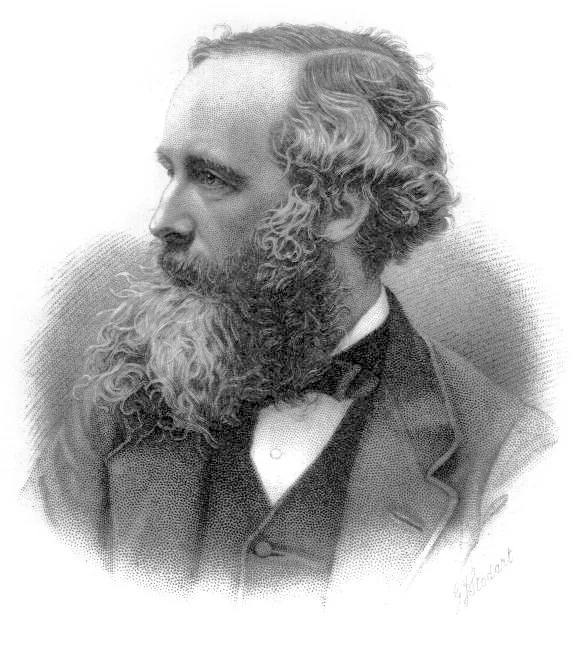
Maxwell’s equations established the theoretical basis for radio when his paper A Dynamical Theory of the Electromagnetic Field was read to the Royal Society on Dec. 8, 1864. James Clerk Maxwell showed that electromagnetic disturbances could travel through space at a speed consistent with light, connecting electricity, magnetism and optics in one theory.
Published in 1865, the paper supplied a physical explanation for waves that later experimenters would generate and detect. For amateur radio, its significance reaches from the fields around an antenna to the energy carried by a signal across space.
Maxwell’s Equations Connected Changing Fields
Maxwell brought together earlier discoveries about electric charge, currents and magnetic induction. His crucial addition accounted for the magnetic effect of a changing electric field, now described through the displacement-current term. A changing magnetic field also produces an electric field.
Together, those relationships allow electromagnetic disturbances to propagate through a vacuum. The predicted wave speed depended on electrical and magnetic quantities that could be measured in the laboratory. Its agreement with the measured speed of light supported Maxwell’s conclusion that light was an electromagnetic wave.
The Theory Preceded Experimental Radio
The Dec. 8 milestone was the reading of a scientific paper, not a demonstration of a working radio link. Maxwell’s analysis supplied a prediction that could be tested. The paper appeared in Philosophical Transactions of the Royal Society of London the following year.
Heinrich Hertz later generated and detected electromagnetic waves experimentally, confirming the central prediction. Practical wireless communication followed through further work on transmitters, receivers and antennas. The theory and the equipment developed at different times, with experiments establishing how the predicted waves behaved.
Antennas Convert Circuit Energy Into Radiated Fields
An amateur transmitter drives changing currents and charges in an antenna. Those changes produce electric and magnetic fields, and part of the supplied energy leaves the antenna as radiation. A receiving antenna responds to an arriving field by developing an electrical signal.
Antenna dimensions, conductor arrangement and surrounding materials affect that interaction. Maxwell’s equations, combined with the properties of the materials and the antenna geometry, provide the framework for calculating the fields. They explain why radiation patterns and coupling depend on more than transmitter power alone.
Frequency Sets the Scale of the Wave
Radio waves and visible light are electromagnetic radiation at different frequencies. In free space, wavelength equals the speed of light divided by frequency. At 14 MHz, for example, the wavelength is about 21.4 meters. That relationship helps explain the physical scale of familiar HF antennas.
A complete antenna design must also account for conductor thickness, insulation, nearby objects and the feed arrangement. The wavelength calculation gives a starting scale; the field relationships describe how the actual structure behaves.
The lasting contribution of the 1864 paper was a testable account of energy traveling through electromagnetic fields. It provided the theoretical foundation for radio before practical wireless systems existed.
Sources and Further Reading
- Royal Society Archives: Maxwell’s Paper, Read Dec. 8, 1864
- James Clerk Maxwell: A Dynamical Theory of the Electromagnetic Field (1865)
- University Physics, Volume 2: Maxwell’s Equations and Electromagnetic Waves
- MIT: Electromagnetics and Applications