
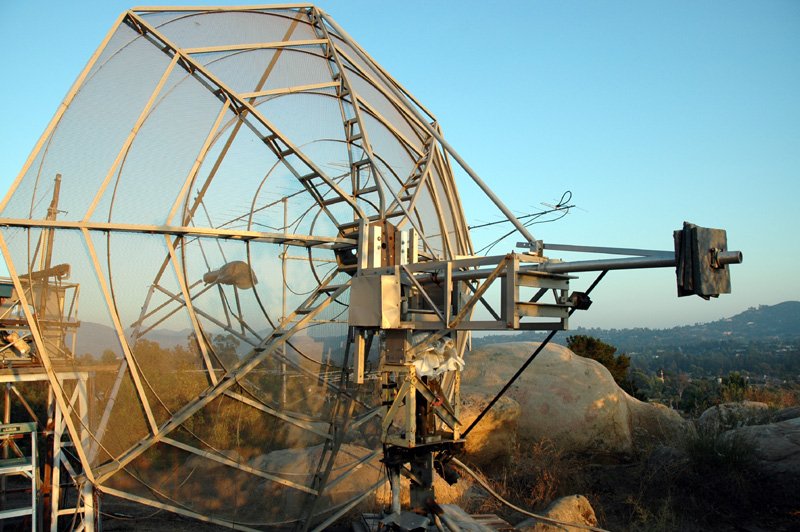
23-Centimeter Moonbounce Plan Points to 1299 MHz in 2027
Back to NewsIARU Region 1’s VHF committee has recommended moving the preferred operating segment for 23-centimeter moonbounce to 1299 MHz beginning January 1, 2027. The recommendation would help coordinate Earth–Moon–Earth contacts as countries introduce Galileo-protection measures that allow substantially more transmitter power above 1298 MHz than around the traditional 1296 MHz operating frequencies.
For U.S. operators in Region 2, the recommendation matters because European moonbounce stations may begin operating near 1299 MHz. That frequency is already within the FCC-authorized U.S. amateur band, allowing suitably equipped American stations to follow the activity. The CEPT power limits apply according to national implementation; they do not change U.S. operating privileges.
The committee recommendation identifies 1299.000–1299.650 MHz as the preferred moonbounce segment. It forms part of a supplemental band plan for countries implementing CEPT’s new conditions, while retaining a role for the existing plan where those conditions have not been introduced.
Why the Power Limits Matter
The underlying change comes from ECC Decision (25)01, approved by CEPT in June 2025 to protect receivers using Europe’s Galileo satellite-navigation system. Galileo’s E6 signals overlap the amateur 23-centimeter band, where amateur operation has secondary status.
For countries applying the decision’s technical measures, narrowband amateur operation between 1296 and 1298 MHz is limited to approximately 50 watts of transmitter power. Between 1298 and 1300 MHz, the general narrowband limit rises to approximately 158 watts.
A separate provision permits approximately 500 watts for narrowband EME in 1298–1300 MHz when a symmetric high-performance antenna points at least 15 degrees above the horizon. The decision gives boresight gain of at least 30 dBi as an example of the required antenna performance.
These are transmitter-power limits, defined as power delivered to the station antenna, rather than effective isotropic radiated power. The distinction matters for high-gain dishes, which concentrate the transmitted energy into a narrow beam.
Moving the preferred EME segment into the higher-frequency range would place activity where that greater power allowance is available. The antenna and elevation conditions still apply: The 500-watt provision does not extend to operation below 15 degrees elevation.
International Contacts Depend on Coordination
Moonbounce stations transmit toward the Moon and receive the weak signal reflected back to Earth. Both ends of an international contact must agree on operating frequencies, even when their national regulations differ.
If activity shifts toward 1299 MHz, stations elsewhere will need suitable coverage to work those operators on the same frequency. Contacts using different transmit and receive frequencies are another possibility, requiring compatible station arrangements and advance coordination.
The Vienna committee minutes record 26 votes in favor of the supplemental plan, with none against or abstaining, and forward it to the conference’s final plenary. The September issue of 432 and Above EME News reports the conference recommendation and January transition date.
January 1 is the recommended date for the preferred EME segment. Each administration’s implementation determines the legal operating conditions in its country, and the regional recommendation does not itself change another country’s amateur license rules.
Sources and Further Reading
- IARU Region 1: Vienna Conference C5 Papers, Recommendation VIE26_C5_Rec_02, and Committee Minutes
- CEPT: ECC Decision (25)01, Including Annex 1 Power and Antenna Conditions
- 432 and Above EME News: September 2026
- KA1GT: Technical Considerations for Moving 23-Centimeter EME Frequencies
- IARU: WRC-23 Outcome for the 23-Centimeter Band