
I’ve always felt that the 60-meter ham band was somewhat of an oddity with limited capability and not really worth the effort. Other factors, like channelized operation, low power limits, and secondary status are puzzling and off-putting. But now, a new order from the Federal Communications Commission helps to solidify and clarify our use of this band and will hopefully make it more appealing to a wider audience.
What This FCC Order Does From a Ham’s Perspective
The FCC has formally allocated 5351.5–5366.5 kHz to the Amateur Radio Service on a secondary basis, aligning U.S. rules with the worldwide 60-meter allocation adopted at WRC-15.
Importantly, the FCC did not replace the existing U.S. channelized structure. Instead, it added a second operating model. As a result, U.S. amateurs now have two distinct and legal ways to operate on 60 meters, each with clearly defined rules and limits.

New 15 kHz Free-Tuning Segment Added
This is the most significant change affecting amateur radio is the addition of new bandwidth.
U.S. amateurs may now operate anywhere within 5351.5 to 5366.5 kHz, rather than being confined to fixed channel center frequencies, provided all of the following rules are met:
- The amateur allocation is secondary, so harmful interference rules apply.
- Maximum permitted power is 9.15 watts ERP. Antenna gain must be taken into account.
- Maximum occupied bandwidth is 2.8 kHz.
- Permitted emission types include CW, SSB voice, and narrow digital modes that fit within the bandwidth limit.
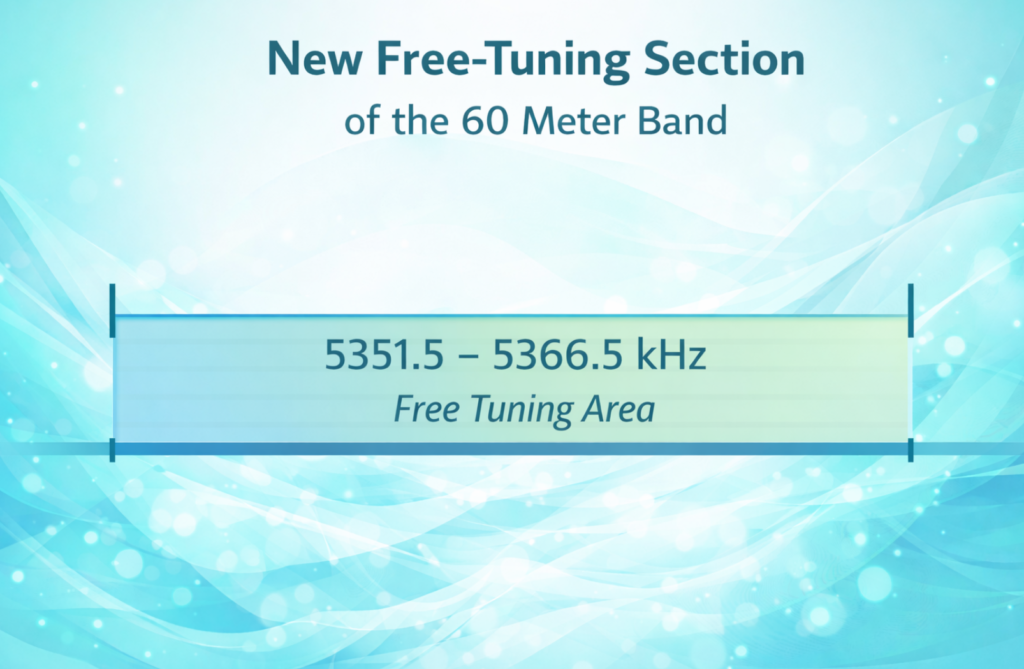
In practical terms, this means you can tune freely anywhere within the 15 kHz segment and choose operating frequencies based on activity and interference, rather than being locked to preset channels. Bandwidth—not channel spacing—is now the primary constraint.
This operating model closely matches how many other countries already manage the 60-meter band and demonstrates that channelization is not technically required for spectrum sharing. It is a regulatory choice, and one that the FCC has stuck with, at least for the four original channels.
How 60-Meter Works Now: A Hybrid Band
With this order, 60 meters is no longer strictly a channelized anomaly. It is now a hybrid band with two coexisting operating regimes.
- The contiguous 15 kHz segment allows free tuning at low ERP using bandwidth-based limits.
- The legacy channels allow higher ERP but require strict adherence to fixed center frequencies.
Both are legal. Both are secondary. Both are usable today.
Which one you choose depends on operating goals, propagation conditions, and power needs.
The Legacy 60-Meter Channels Still Exist
In addition to the new contiguous segment, the FCC explicitly retained the existing discrete 60-meter channels used by U.S. amateurs for years. These channels remain fully authorized and unchanged.
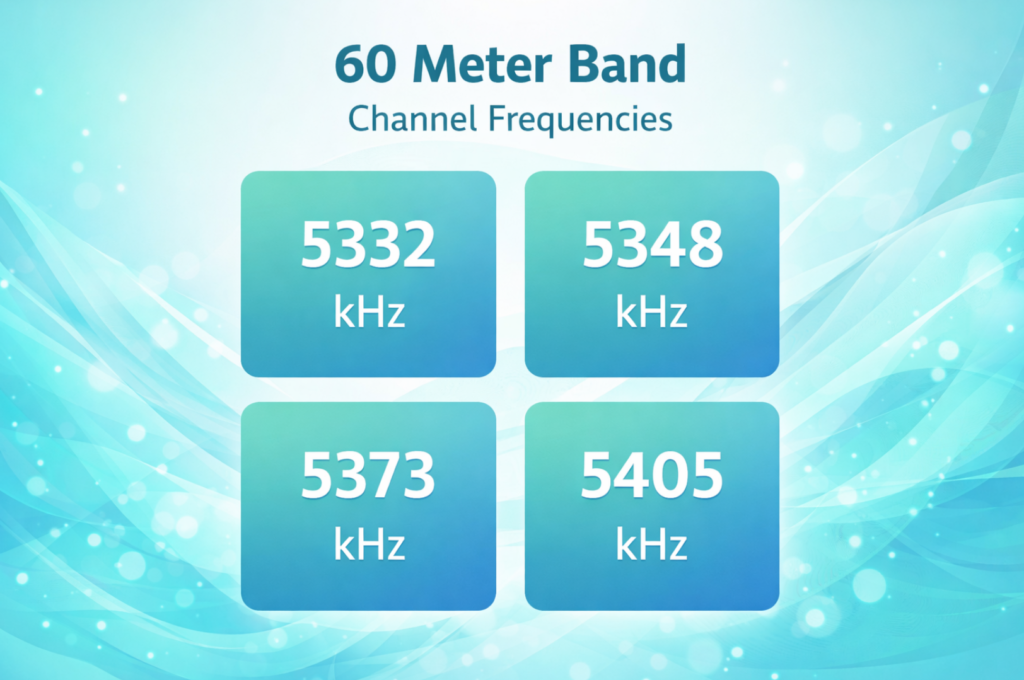
The authorized channel center frequencies are: 5332, 5348, 5373, and 5405 kHz.
Operation on these channels remains secondary and continues to use USB voice or compatible emissions centered on the assigned frequency.
The maximum permitted power on the channelized frequencies is 100 watts ERP, significantly higher than the free-tuning segment.
Occupied bandwidth remains limited to approximately 2.8 kHz, supporting USB voice, CW, and compatible narrow digital modes.
Operation outside the defined channel center frequencies is not permitted when using the channelized rules.
Why Channelization Wasn’t Removed Entirely
The existence of the new free-tuning segment makes one thing clear: Channels are not a technical necessity. Channelization remains in place primarily to simplify coordination with federal primary users and to manage interference risk at higher power levels. Fixed frequencies make monitoring and enforcement easier when higher ERP is allowed.
The new contiguous allocation shows that bandwidth-based sharing works, as it already does internationally. Channelization persists as a policy tool, not a technical requirement.
Bottom Line for 60-Meter Amateur Use
The FCC 60-meter ham band is no longer just a handful of fixed channels. US amateurs now have a true 15 kHz band segment with free tuning, alongside continued access to the familiar high-power channels. The rules are clearer, the allocation is more secure, and U.S. practice is better aligned with the rest of the world. If you’ve avoided 60 meters in the past because it felt awkward or restrictive, it’s worth another look.
Reference to the Official FCC Order
The changes discussed in this post come from FCC Report and Order FCC 25-60, issued by the Federal Communications Commission. The full, official document is available directly from the FCC:
https://docs.fcc.gov/public/attachments/FCC-25-60A1.pdf