
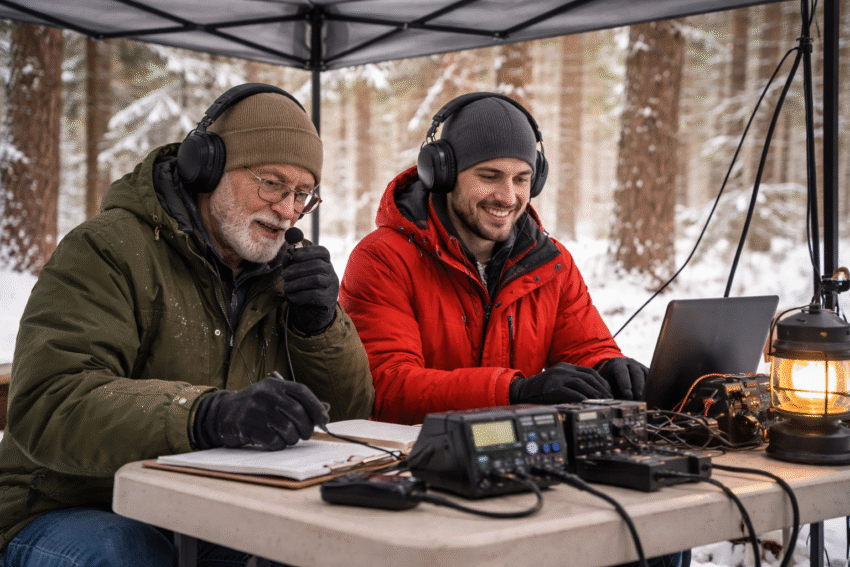
Winter Field Day isn’t a contest in the traditional sense. It’s an operating event, an “experience” if you ask its founders. If you approach it like a sprint for raw QSO counts, you’re missing the point, and worse, you’re missing what Winter Field Day does reward: Versatility, planning, and realistic emergency-style operation in less-than-ideal conditions.
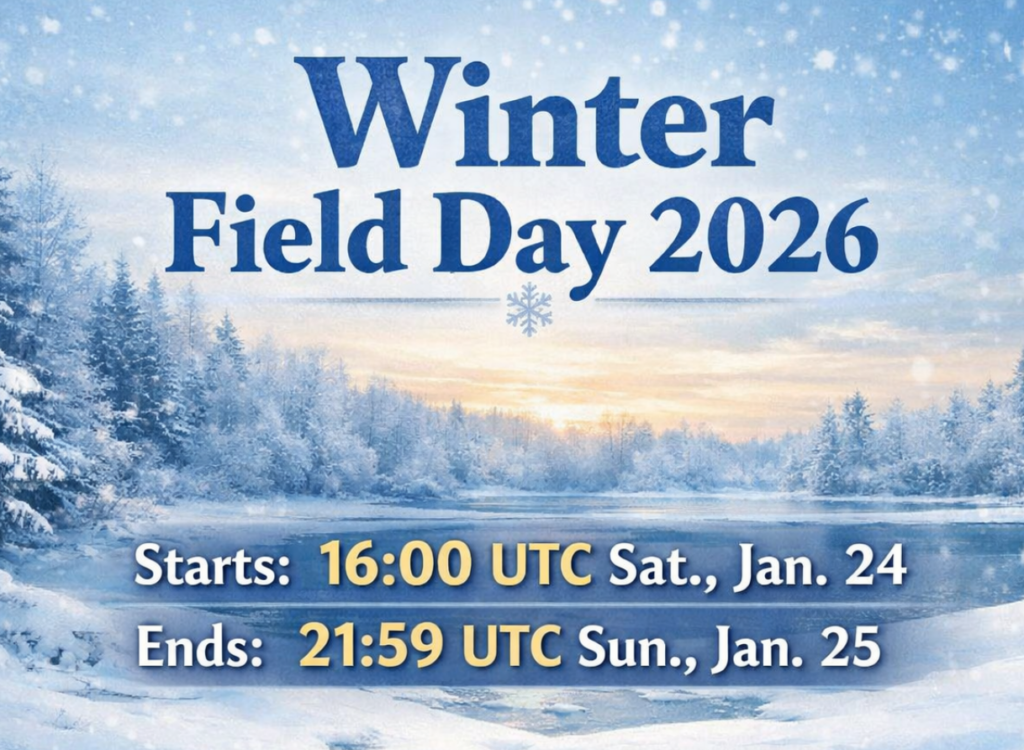
Winter Field Day 2026 starts at 16:00 UTC on Jan. 24 and ends at 21:59 UTC on Jan. 25. The annual event provides a number of operational objectives and scoring multipliers that can help you rack up points very quickly. Considering your objectives is an important step in planning your Winter Field Day excursion. Whether you’re setting up all alone on a frozen lake or meeting up with friends at a local park, have a plan to maximize your effort by putting those scoring multipliers to work.
In this article, I will break down how Winter Field Day 2026 works, where the easy multipliers live, and how to turn the event into something that’s both high-scoring and easy enough to be approachable by newer hams. It’s also a great recruiting opportunity, but we’ll get in to that later.
The Big Picture: What Winter Field Day Is Really Measuring
At its core, Winter Field Day asks a simple question: Can you set up a station, operate it correctly, and exchange meaningful information under less-than-ideal conditions?
That philosophy shows up everywhere in the rules. Certain popular modes are excluded, repeaters are off-limits, and objectives emphasize things like band diversity, alternative power, message handling, and sustained operating time. This isn’t about clicking macros—it’s about demonstrating that you can communicate when it actually matters. Understanding that mindset makes the rest of the rules fall neatly into place.
The Exchange: Simple, Consistent, and Easy to Practice
The Winter Field Day exchange is very straightforward. Every contact includes four pieces of information: Your callsign, your category number (how many transmitters you’re actively operating), your class (Home, Indoor, Outdoor, or Mobile), and your ARRL/RAC section.
Once you pick your category, class, and location, they must stay the same for the entire event. That consistency is important, especially if you’re operating with newer hams who may be logging or operating for the first time. It removes ambiguity and keeps exchanges fast and clean. If you’re mentoring someone new, this is a perfect opportunity to show them how structured exchanges work—and why accuracy matters more than speed.

Understanding Winter Field Day Categories and Classes
Categories are simply the number of transmitters you can operate simultaneously with enough operators to staff them. If you have two radios but only one operator, you’re still a one-station operation.
Classes describe where and how you’re operating. Home, Indoor, Outdoor, and Mobile each exist to reflect different operating environments. The rules are intentionally flexible here. If you’re unsure, just choose the class that best reflects the spirit of how you are operating.
Where Points Come From: The Objectives Matter
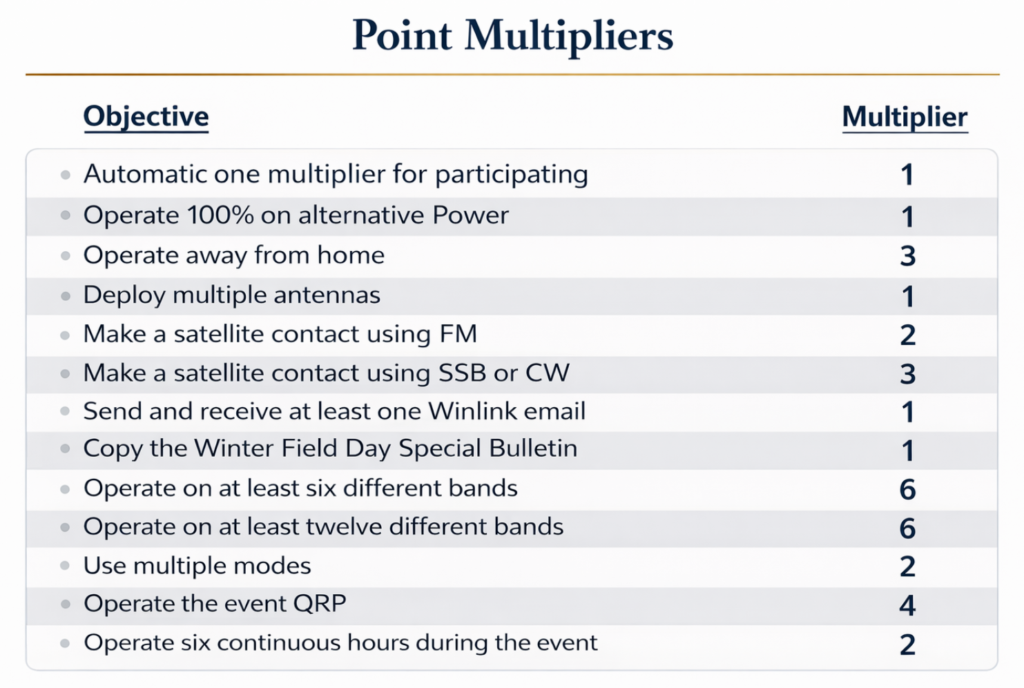
QSOs are just the beginning. Phone contacts are worth one point, while CW and digital contacts are worth two. But it’s the objective multiplier (OM) that really boosts your final score. Your total QSO points get multiplied by your objectives plus one: (q*(o+1)). That means even modest QSO totals can turn into excellent scores if you focus on completing as many objectives as you can.
Some objectives are low-effort and high-reward. For example, operating away from home is a huge one, offering a substantial multiplier boost just for setting up more than half a mile from your residence. Using multiple modes is another easy win—working both phone and digital (or CW) maximizes your score.
The Three Objectives That Really Move the Scoring Needle
If you want to understand Winter Field Day scoring quickly, here’s the key insight: A handful of objectives dominate the scoring math. These aren’t subtle bonuses or “nice to have” checkboxes—they are the multipliers that separate modest scores from jaw droppers, even with an average QSO count.

Six Bands (×6) and Twelve Bands (×6): Band Diversity Is King
The largest single objective multipliers in Winter Field Day come from operating across multiple bands. Making at least three contacts on six different bands earns a ×6 multiplier, and stepping up to twelve different bands earns another ×6 multiplier. The six bands used for the first objective count toward the twelve-band objective, so these are cumulative goals, not separate paths.
What makes these objectives so powerful is that they reward operating flexibility, not station size. HF alone won’t get you there—you’re expected to think beyond a single comfort band and incorporate VHF, UHF, and potentially microwave allocations. Even modest stations can achieve the six-band objective by intentionally planning for a mix of HF and local work, and the rules explicitly encourage participants not to overlook underused bands like 1.25 meters (220 MHz).
These objectives dwarf most others because they reflect a core emergency-communications skill: The ability to adapt to changing propagation and use whatever spectrum is available.
QRP Operation (×4): Fewer Watts, Bigger Reward
Operating the entire event at QRP power levels earns a ×4 multiplier, making it one of the most impactful objectives in the rules. To qualify, every station in your operation must stay at or below 10 watts on phone or 5 watts on CW or digital for the duration of the time you choose to operate.
This objective isn’t about suffering through weak signals—it’s about demonstrating efficiency, station optimization, and operator skill. When combined with band diversity objectives, QRP operation can dramatically amplify a score while reinforcing exactly the kind of disciplined operating Winter Field Day is meant to promote.
It’s an all-or-nothing objective, but for stations already comfortable running low power, it’s one of the best returns on effort in the entire event.
Operating Away From Home (×3): The Core Scenario Test
Operating more than half a mile from your home location earns a ×3 multiplier, and it’s one of the foundational objectives of Winter Field Day. This objective tests whether you can establish a working station somewhere other than your normal operating position—an explicit nod to real-world emergency scenarios.
While ×3 is smaller than the band and QRP multipliers, it’s still substantial, and it pairs naturally with almost every other objective. More importantly, it reinforces the spirit of the event: portability, adaptability, and planning ahead rather than relying on permanent infrastructure.
Digital Modes, Satellites, and Message Handling
Digital operation plays a big role in Winter Field Day, but not all digital modes are treated equally. Modes that can’t effectively pass emergency traffic, like FT8, are excluded. Instead, the focus is on modes that encourage real message handling like RTTY and JS8Call.
Sending and receiving a Winlink email is a perfect example. It’s a simple objective, it’s highly realistic from an emergency communications standpoint, and it introduces newer operators to a tool they may not have used before.
Satellite contacts don’t add QSOs to your log, but they add valuable multipliers—and they’re a great way to spark curiosity among visitors or newer hams watching the operation.
Operating Style: Slow Down and Let New Hams Participate
Winter Field Day is one of the best on-the-air events for introducing newcomers to amateur radio because the pressure is low and the goals are broad. The emphasis is on doing things right and achieving your goals by completing as many objectives as possible.
Let new operators log. Let them call CQ. Let them “play radio”! Share your license privileges with them as a control operator. Let them fumble an exchange and try again. The rules explicitly encourage practicing additional information exchange beyond the minimum, which makes Winter Field Day feel more like a learning lab than a competition. It’s a great opportunity to expose people to the hobby and maybe even do some recruiting in the process.
Why Winter Field Day Is a Recruitment Tool in Disguise
Public-facing Winter Field Day sites are encouraged, and the official materials actively invite the public to stop by, ask questions, and even go on-air under supervision of a control operator. That’s not an accident; it’s by design. It’s a core concept of the entire event.
Winter Field Day showcases amateur radio as something practical, approachable, and still deeply relevant. You’re not just “making contacts”—you’re demonstrating communication skills, adaptability, and problem-solving in real time. Show off the fact that ham radio is a vibrant, thriving, and growing hobby that encourages diversity and offers “something for everyone”.
Final Thoughts: Play the Game the Rules Are Asking You to Play
If there’s one takeaway from the Winter Field Day 2026 rules, it’s this: The event rewards planning, versatility, and thoughtful operation, not brute force.
Read the objectives early. Study them if you need to. Choose a few that align with your station and your interests. Build your operating plan around them. Then relax and enjoy the weekend. You’ll score better, learn more, and quite possibly inspire the next generation of hams along the way.